


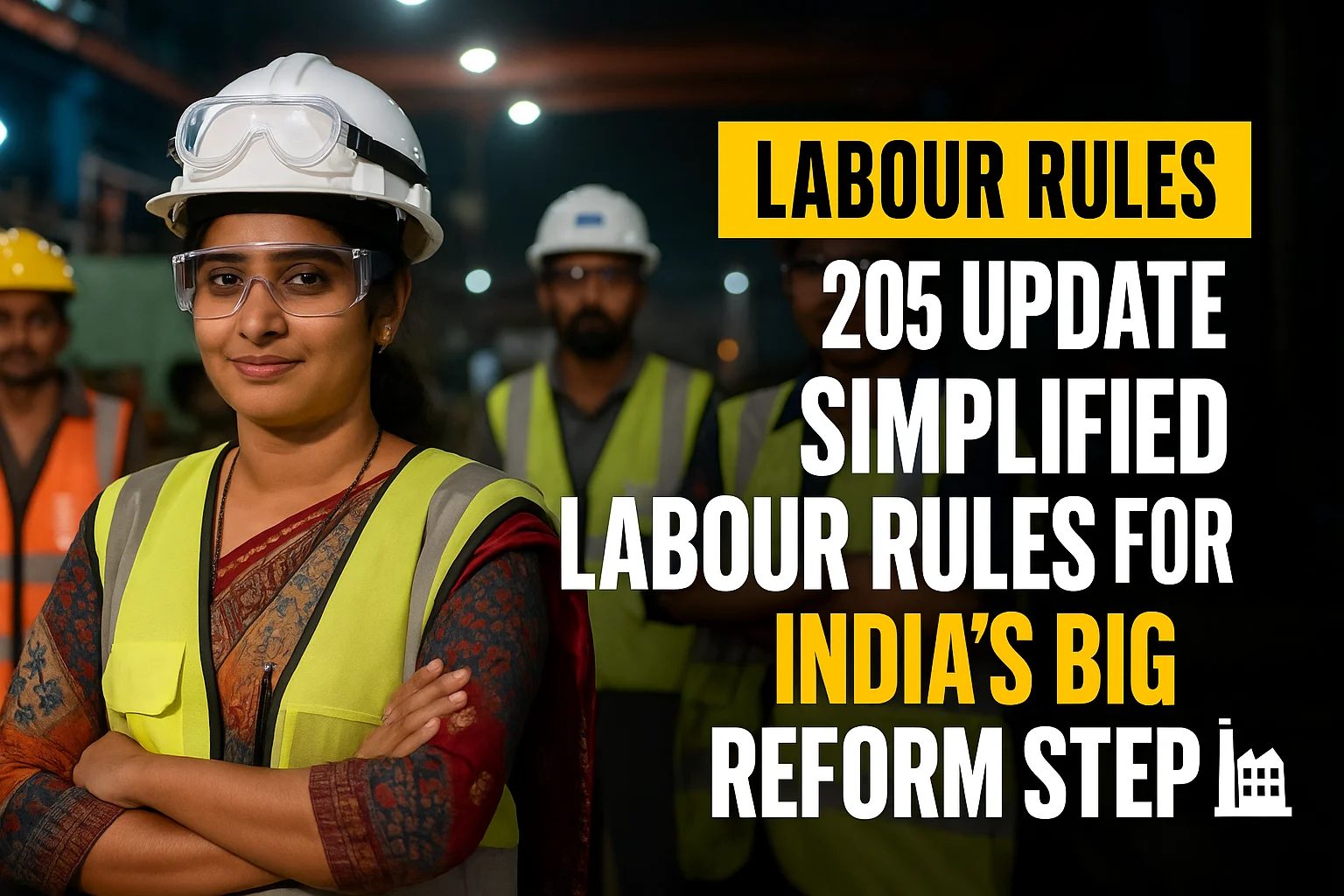
India is stepping into a new era of work. For decades, businesses and workers navigated a maze of 29 different labour laws—complex, overlapping, and outdated. But today, the country stands at the edge of one of its biggest labour reforms ever.
The Government has consolidated nearly 30 separate laws into just four Labour Codes, creating a modern, simplified, and transparent system designed for a fast-changing economy. These new codes aim to empower workers, support businesses, and build a stronger, fairer, and more inclusive labour ecosystem.
Below is a clear, website-ready breakdown of all key provisions, major changes, FAQs people often ask, and the full significance of the new Labour Codes.
Key Takeaways
- India has consolidated 29 labour laws into 4 comprehensive Labour Codes.
- The Four Labour Codes are:
- Code on Wages, 2019
- Industrial Relations Code, 2020
- Code on Social Security, 2020
- Occupational Safety, Health & Working Conditions Code, 2020
- The reforms simplify compliance, modernize labour regulations, and protect workers’ rights while supporting ease of business.
- The new framework promotes fair wages, social security, safer workplaces, and faster job creation.
What Are the 4 New Labour Codes?
India’s new labour law framework consists of the following four codes:
- Code on Wages, 2019
- Industrial Relations (IR) Code, 2020
- Code on Social Security, 2020
- Occupational Safety, Health and Working Conditions (OSH) Code, 2020
Each code brings together multiple old laws into one streamlined structure.
What Is the Labour Code 2025 in India?
The term “Labour Code 2025” refers to the implementation timeline of India’s new Labour Codes.
While the four codes have already been passed by Parliament, they are expected to be fully enforced nationwide by 2025, once states complete their rule-making process.
It represents India’s largest labour reform in independent history—designed to boost formal employment, improve worker safety, and promote a business-friendly environment.
Is Above ₹21,000 Salary Eligible for Bonus in India?
Under the Code on Wages, 2019, the eligibility criteria for bonus remain similar to the previous law:
- Employees earning up to ₹21,000 per month are eligible for statutory bonus.
- Those earning above ₹21,000/month are not automatically eligible, unless a company voluntarily offers it.
Labour at the Core of India’s Growth
India’s labour force is expanding at a remarkable pace:
- Employment rose from 47.5 crore (2017–18) to 64.33 crore (2023–24)
- Unemployment reduced from 6.0% to 3.2%
- 1.56 crore women joined the formal workforce
- Poverty has declined, and social protection coverage has grown rapidly
The Labour Codes aim to further strengthen this positive momentum by creating a more efficient and inclusive labour market.
Why Were 29 Labour Laws Codified Into 4 Labour Codes?
The Government’s goal behind codification was simple:
to simplify, update, and harmonize India’s complex labour framework.
Key reasons:
- Simplified compliance (single registration, single license, single return)
- Streamlined enforcement by reducing multiple authorities
- Modernizing outdated laws, many of which were written before independence
- Promoting employment and ease of business
- Bringing uniformity across labour regulations
Detailed Breakdown of the Four Labour Codes
1. Code on Wages, 2019
This Code merges four major laws regarding wages, minimum wages, bonus, and equal remuneration.
Major Highlights:
- Universal minimum wage for all workers
- National floor wage to ensure uniformity across states
- Wage fixation based on skill, region, and working conditions
- Strict rules for timely and fair wage payment
- Overtime at 2x the normal wage
- Gender-neutral pay and employment rules
- Simplified compliance with “Inspector-cum-Facilitator” system
- Decriminalization of minor offences
2. Industrial Relations (IR) Code, 2020
The IR Code aims to balance worker rights with industrial stability.
Major Highlights:
- Fixed Term Employment with full benefits
- Retraining Fund for retrenched workers
- Recognized trade union for effective bargaining
- Expanded coverage for supervisory staff
- Lay-off/Closure approval threshold raised from 100 to 300 workers
- Work-from-home officially allowed
- Faster dispute resolution via two-member tribunals
- Mandatory 14-day notice for strikes and lockouts
- Digital records and communication
3. Code on Social Security, 2020
This Code extends social protection to all categories of workers—including gig and platform workers.
Major Highlights:
- National coverage of ESIC
- Time-bound EPF inquiries
- Reduced EPF appeal deposit
- Self-assessment for construction cess
- Social Security Fund for gig/platform workers
- Expanded definition of dependents
- Uniform wage definition for EPF, gratuity, pension
- Gratuity for fixed-term employees after 1 year
- Digital, risk-based inspections
- Vacancy reporting to career centres
4. Occupational Safety, Health & Working Conditions (OSH) Code, 2020
This Code merges 13 laws into one comprehensive safety and working-conditions framework.
Major Highlights:
- Unified electronic registration for all establishments
- Simplified one-license-one-return system
- Benefits for migrant workers including travel allowance
- Free annual health checkups
- Night shifts allowed for women with safety measures
- Expanded definitions for journalists and cine workers
- National database for unorganized workers
- Strong safety committees (500+ workers)
- National OSH Advisory Board
- Decriminalization and compounding of offences
- Working hours capped at 8 hours/day, 48 hours/week
- Better protections for contract labour
The Transformative Impact of Labour Codes
The four Labour Codes together aim to:
- Modernize India’s labour laws
- Protect every worker—organized, unorganized, gig, platform
- Improve ease of business
- Promote investment and job creation
- Strengthen wage security, safety, and social protection
- Simplify compliance through digital systems
- Build a transparent, technology-driven regulatory framework
These reforms mark a major shift toward a future-ready labour market.
Conclusion
India’s four new Labour Codes are more than legal reforms—they represent a new social contract between workers, employers, and the economy.
They simplify compliance, ensure fair wages, enhance safety, and expand social security to millions, including gig and platform workers.
As India moves toward full implementation by 2025, these reforms position the country for faster growth, stronger worker protection, and a more equitable economy.
References
Labour.gov.in
https://labour.gov.in/sites/default/files/labour_code_eng.pdf
https://labour.gov.in/sites/default/files/the_code_on_wages_2019_no._29_of_2019.pdf.
Ministry of Labour & Employmen
https://www.pib.gov.in/newsite/pmreleases.aspx?mincode=21
https://www.pib.gov.in/PressReleasePage.aspx?PRID=2160547
https://www.pib.gov.in/PressReleasePage.aspx?PRID=2147160
Click here to see pdf